
How Zero-ETL Helps Multi-Cloud Organizations Get to Insight Faster
Multi-cloud enables an organization to utilize a specific cloud provider for unique tasks. For example, an organization can use one cloud vendor for customer relationship management (CRM) and another for disaster recovery, analytics, and advanced machine learning workloads.
In multi-cloud environments, data lives in siloed repositories. Data collection for organizations operating multi-cloud systems is not a problem. Consolidating data from the two environments fast enough for quicker decision-making is the constraint.
Historically, integrating an organization's data from multiple sources into a single repository requires building custom extract, transform, and load (ETL) pipelines. For organizations without dedicated engineering teams, unifying data from multiple sources can become a costly initiative. In many instances, this initiative is abandoned, resulting in delayed reporting, missed donor trends, or duplicated outreach campaigns.
What Zero-ETL Is and Why It Matters
Zero-ETL integration eliminates the need to build, manage, and maintain custom data pipelines to implement ETL tasks. Instead of spending long hours and resources writing code to extract data and stage it before loading into a data warehouse, Zero-ETL provides a no-code/low-code solution to replicate data directly into a target destination in near-real time.
For organizations using Salesforce for CRM and AWS for operating digital infrastructures, AWS provides Zero-ETL Integration as a no-code/low-code solution for moving data from external and third-party data sources into a single environment (a data lake or data warehouse). Zero-ETL integration between Salesforce and AWS enables near real-time availability of data in AWS without building and maintaining customized data pipelines. This significantly reduces engineering effort and enables organizations to accelerate data insights, including machine learning and generative AI workload deployment.
Use Case: Nonprofit Unifying Donor and Operations Data
A large nonprofit uses Salesforce as a CRM, hosting multi-year marketing and donor data (over a million rows of relational data). It uses AWS to host websites and virtual servers for storing archival donor data. Facing 5 to 10% annual donor attrition, the organization wants to:
- Consolidate data from Salesforce (campaigns and donation history) with AWS application logs data
- Build a donor churn prediction model that identifies high-risk donors and reduces attrition by 5% annually
- Build a dashboard that enables leaders to run queries using natural language and get automated visualizations
The Solution
Is your data ready to support better decisions? Let's find out.
Schedule a Free CallThe nonprofit needs a single environment that can store, query, build, train, and make machine learning predictions. Amazon Redshift fits this use case because of its SQL-based analytics and built-in machine learning capability. It offers key advantages:
- Scalable cloud data warehouse that can handle terabyte- and petabyte-scale data sizes
- Flexible deployment options: Redshift Serverless for unpredictable workloads that scales automatically, or provisioned clusters for predictable tasks
- AWS manages the servers, reducing the need for a dedicated database administrator and on-premises hardware
- Built-in machine learning features using SQL statements and functions in Redshift Query Editor V2 to build, train, and run predictions
Architecture Overview
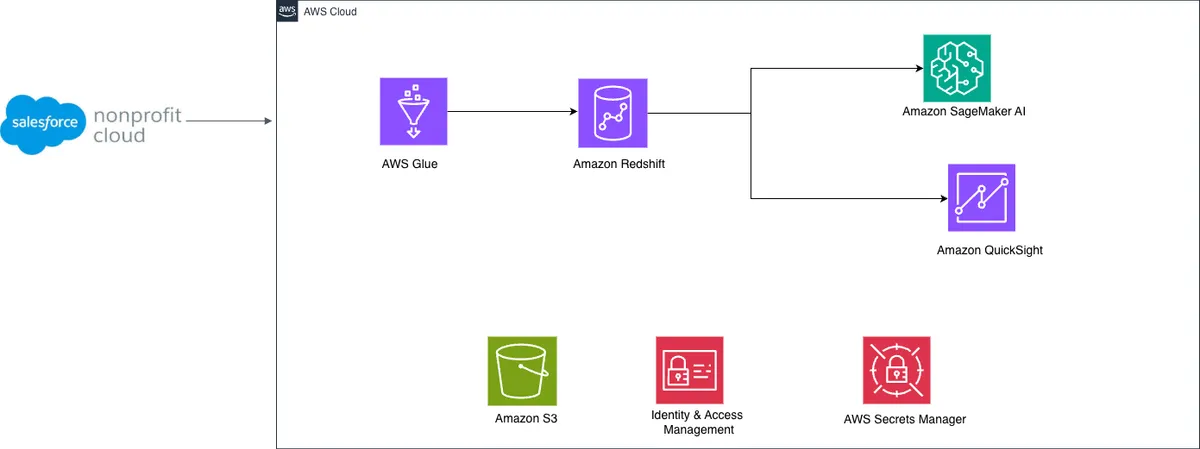
The architecture shows data movement from Salesforce Nonprofit Cloud into AWS:
- Salesforce Bulk API setup enables large data movement per API call
- AWS Glue configuration sets Salesforce as the data source while the Zero-ETL integration delivers data into an Amazon Redshift database
- Amazon Redshift Query Editor V2 uses SQL statements and functions to build and train machine learning models
- Amazon SageMaker AI integrates with Redshift under the hood, leveraging Autopilot models for the donor churn prediction model
- AWS Identity and Access Management and AWS Secrets Manager manage data access and protection, ensuring secured end-to-end data movement
- Amazon QuickSight enables non-technical users (executive leaders) to run queries in natural language and get instant visualizations
- Amazon Simple Storage Service (Amazon S3) serves as the underlying storage layer
Cost Management
Zero-ETL removes the costs and overhead of building and maintaining complex ETL pipelines, but it is not a one-stop shop. Organizations running Zero-ETL workloads must implement cost-optimization strategies through query monitoring, usage alerts, and data lifecycle management.
Before You Implement
Technology accelerates insight, but it doesn't guarantee adoption. Organizations must ensure executive alignment and establish clear KPIs with measurable success criteria before starting. Implementing Zero-ETL data processing and transformation within Amazon Redshift may be required to align with organizational business goals. Have a clear roadmap before starting.
Want to go deeper?
See how J-MO Global applies these ideas to organizations like yours. Our discovery call is free, 30 minutes, and focused on your situation.
Related Articles
How SMBs Can Find and Use the Data They Already Have
Many small and medium businesses have more useful data than they realize. Learn how to identify, organize, and make better use of your data assets.
Building a Data-Driven Culture in Your Organization
Technology alone is not enough. Learn how to foster a culture where data-informed decision making becomes a regular part of how your team operates.